If you think about it, Metal and its many, many sub-genres is an amazing thing. It is an artistic ecosystem that defies logic, an entire universe built on extremes that somehow finds a way to constantly reinvent itself. To the uninitiated, the casual observer looking in from the safety of the mainstream, it is a monolith of impenetrable noise. They look at it and they think: Just a cacophony, that’s all it is. But it isn’t. Those of us who live and breathe this music know that within that supposed “noise” lies some of the most complex, emotionally staggering, and architecturally brilliant composition in modern music history.
This brings us explicitly to the door of Technical Death Metal. On paper, Tech-Death is a sub-genre governed by a very rigid, almost terrifyingly demanding set of rules. If you were to sit down and write out the blueprint for what a standard Technical Death Metal record should look like, the formula would look exactly like this: play fast as fuck, play as cleverly as fuck, roar and scream in all the right places, make songs people can snap their necks to, and then rinse and repeat until the album ends. Because of that strict, deeply internal formula, Technical Death Metal should, by all accounts, sound entirely uniform. Every band should blur into a singular, high-speed, mechanical rush of sweep-picking and hyper-blasts.
Should. But it doesn’t.
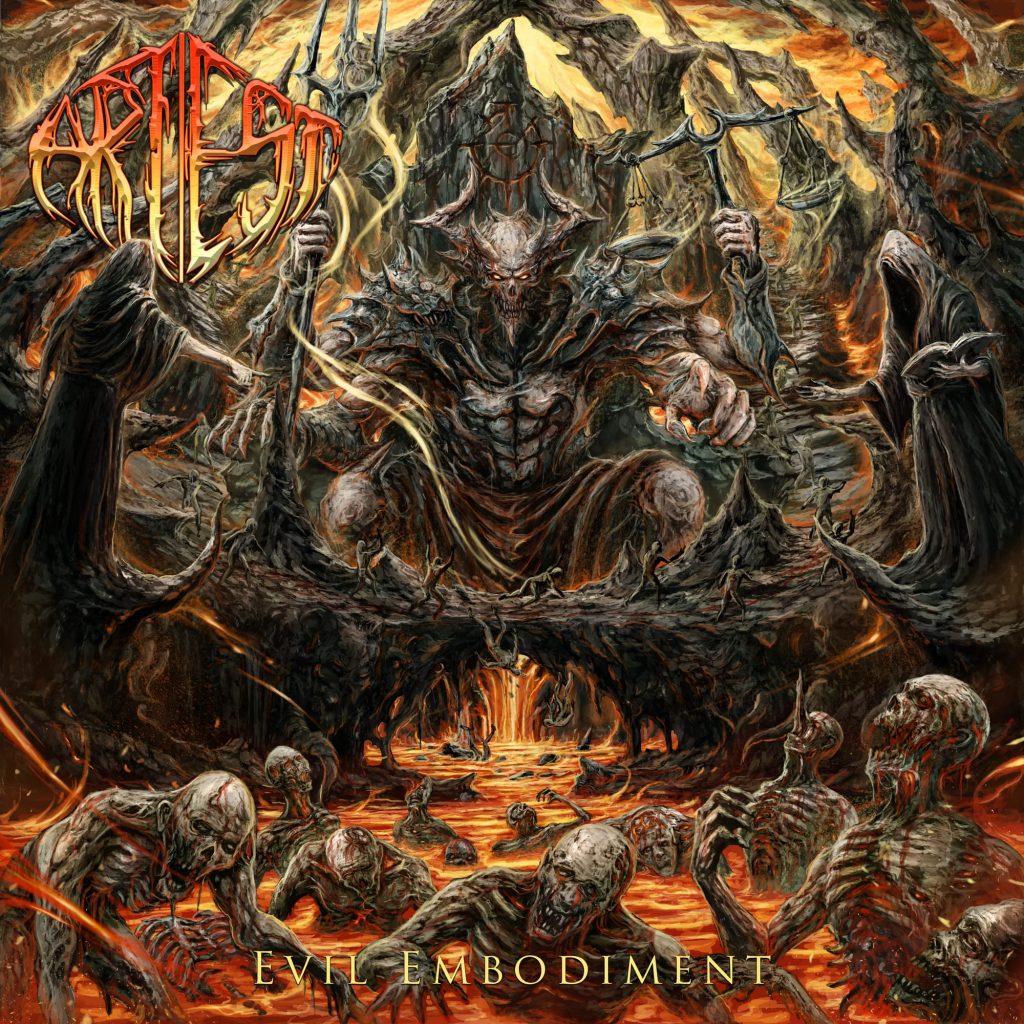
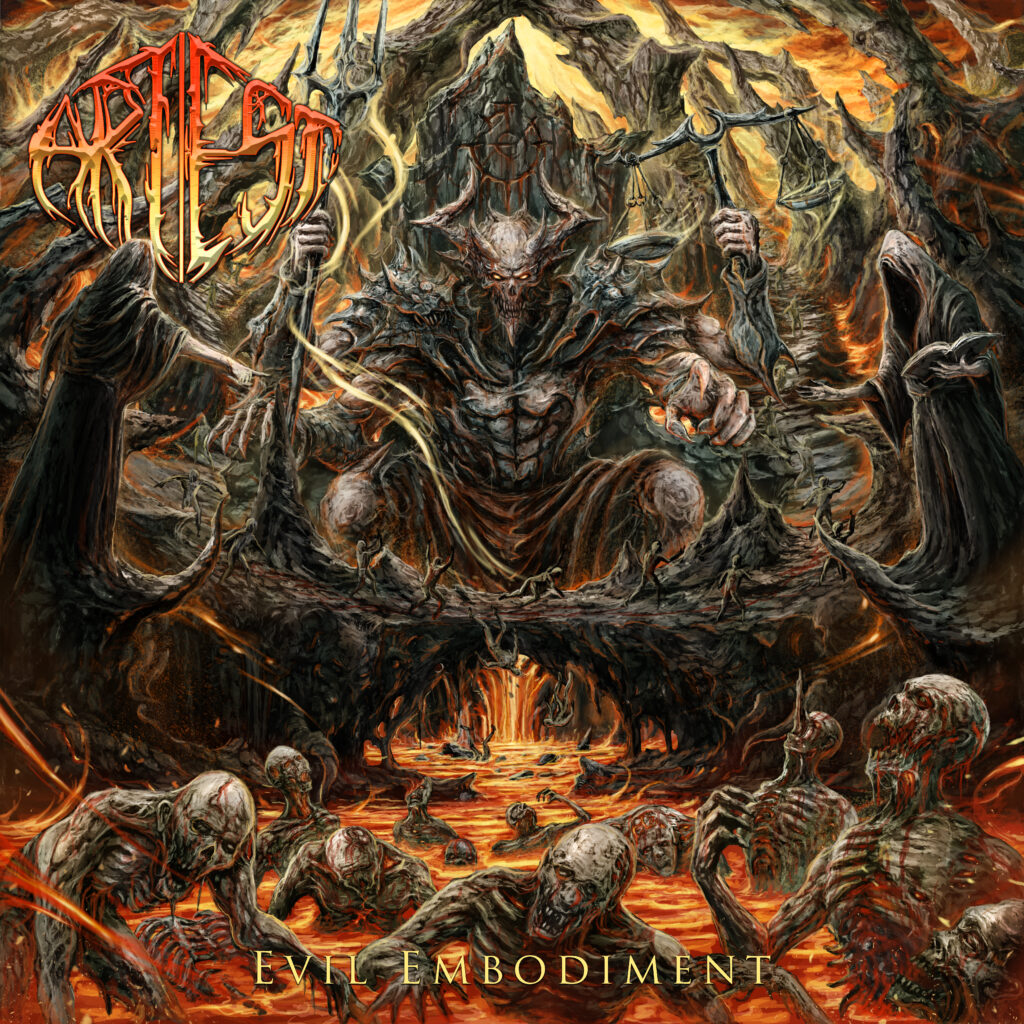
Enter Leipzig, Germany’s own ART|EST and their colossal latest offering, Evil Embodiment. This record is living, breathing, snarling proof that within the boundaries of an aggressive formula, true artists can create something entirely distinct. Do they play fast as fuck? Yes, absolutely. Do they play cleverly as fuck? Undoubtedly. The vocal delivery hits every roar and scream in exactly the right place, while the rhythm section lays down a foundation so utterly punishing that I dare anyone to listen to this record and not walk away with a severe case of whiplash. Yet, Evil Embodiment avoids the classic trap of the genre. It never feels like a sterile exercise in musical gymnastics. It doesn’t feel like a group of guys showing off their music degrees in a soundproof room. Instead, it feels dangerous. It feels like an exploration.
The band dives into the darker questions that sit behind the obvious ones: what happens after life, what might exist between worlds, and what it means to feel something watching from the other side of the veil. That is an ambitious narrative concept for a genre that often defaults to simple gore or sci-fi tropes. ART|EST has built an entire sonic architecture around that specific shadow realm. It is a world where demonic forces, possession, and haunting presences actively blur the boundary between the living and the dead. To achieve that kind of existential dread through the medium of blast beats and drop-tuned guitars requires something more than mere speed. It requires genuine atmosphere and imagination.
To understand how ART|EST pulls off this visual, cinematic feat within the framework of Tech-Death, you have to look at the macro-structure of how the record actually flows. It is a continuous, unbroken journey that moves systematically deeper into the pit. The album opens (after the obligatory intor which I, remarkable, don’t hate) not with a gentle fade-in or an ambient atmospheric warning, but with a declaration of total war. Musically, the early movements of the record, such as the album title track and In The Sky of Dead Ghost, are a showcase of precision picking and tightly coiled riffs, winding around a hyper-fast tempo that immediately fulfills the first rule of the Tech-Death handbook. But if you listen closely to the way the chords shift in the background, there is an underlying harmonic dissonance that creates an immediate sense of panic. It feels like a roof caving in.
As the album progresses, the band explores the reality of possession and unholy surrender, with lyrics that paint a vivid picture of standard reality being systematically torn away as eyes turn to black and faith is shed. The underlying hooks are a sledgehammer. The band drops the hyper-speed technicality for brief moments to deliver absolute monsters of groove, the kind of hooks designed specifically to ensure the live crowd bangs their collective heads in unison. It is heavy, rhythmic, and deeply memorable.
Then, you reach the center of the labyrinth, and it contains the singular moment that completely sums up what this entire record is about, ar least for me. Enter Vale of Shadows. The music at this turning point begins as an absolute onslaught, a pounding, relentless blitzkrieg of blast beats, jagged riffs, and agonizing vocal deliveries that push the listener to the absolute brink. It is pure, unadulterated madness. But then, toward the end of this song, the madness completely stops. The entire onslaught cuts out. The heavy guitars, the drums, the growling vocals, all of it vanishes into thin air. In their place, the band introduces an almost Spanish-sounding guitar interlude. It lasts barely 30 seconds, but its impact is monumental. It is an astonishingly beautiful, melancholic piece of instrumentation that completely alters the atmosphere of the room. It feels as if you have just dragged your bleeding body out of Hell itself and climbed back out into the blinding warmth of the light. You get a fleeting moment to catch your breath, to feel human again, to believe that salvation is possible. And then, just like that, the illusion is shattered. The Spanish guitar vanishes, the heavy wall of sound kicks back in with tenfold intensity, and you are violently dragged right back into the pit by demonic hands, never to be seen again. It is a brilliant piece of musical storytelling. It uses the contrast of silence and beauty to make the subsequent heaviness feel even more terrifying than it did before. The key phrase here is immersive world-building, because that’s exactly what ART|EST do across this entire record. They don’t just write riffs; they construct environments. It just so happens that the specific, horrifying landscape they unveil on Evil Embodiment would have absolutely terrified the shite out of Hieronymus Bosch.
Following the trauma of that descent, the back half of the record deals with the immediate aftermath. The pacing is still of brutal tempo, it’s just that after Vale of Shadows moment of hope, you feel like yoy aee witnessing your own funeral march. The guitars groan and scrape, creating a heavy, suffocating atmosphere that perfectly mirrors the thematic concept of being trapped in the permanent dark of the afterlife. It is erratic, brilliant, and completely unpredictable. The album closes with its longest movement, The Monster Within Myself, running nearly six minutes. It is a fitting conclusion, drawing together all the elements explored across the previous arrangements. It features the blistering speed, the intricate progressive songwriting, the crushing grooves, and the dark melodies. As the final notes ring out into a cold, echoing silence, you are left with a profound sense of closure, and an immediate urge to press play all over again.

When you look at the entire record as a complete piece of work, you can see how intentionally it was put together. From the high-speed assault of the opening to the epic cinematic conclusion, the pacing is meticulous. Evil Embodiment is a triumphant reminder of what Technical Death Metal can achieve when a band values artistry just as much as virtuosity. ART|EST took a rigid formula, executed it with flawless skill, and then used it to paint a terrifying, brilliant picture of the dark. For me, it stands as one of the most impressive modern Technical Death Metal releases I’ve heard in quite some time.
Neil Gray